Play

Countries that moved their capital

Most capitals grew slowly over centuries, but some were chosen, built or swapped on purpose. Countries have moved their capital to get away from a war, to stop one big city from running everything, to sit nearer the middle of their land, or to start again after a disaster. Some moves were settled in a day, others took decades, and in a few places the old capital still does much of the work. Here are 14 countries that moved their capital, with the year the move became official, where it went and why. Some moves take a long time: Indonesia passed a law in 2022 naming Nusantara, on Borneo, as its future capital. Each story also helps you find the right city on the globe.

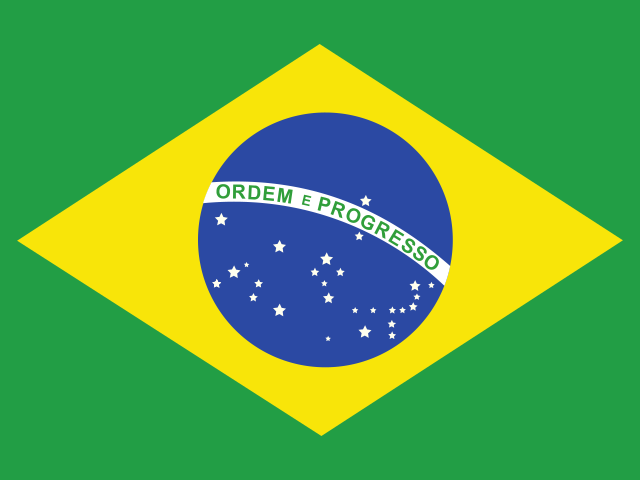
Flag of Brazil

Brazil: from Rio de Janeiro to Brasília (1960)

Rio de Janeiro had been the seat of government since 1763, when the colonial capital moved there from Salvador. Brazil's constitution of 1891 already reserved land on the central plateau for a new capital, but it was President Juscelino Kubitschek who built it. Planned by Lúcio Costa, with buildings by Oscar Niemeyer, Brasília rose from the savanna in about 41 months and was inaugurated on 21 April 1960. The aim was a central, neutral capital that would pull development inland. From the air, its plan looks like an aeroplane or a bird.
Flag of Türkiye

Türkiye: from Istanbul to Ankara (1923)

After the First World War, Istanbul and much of Anatolia were under Allied occupation, so Mustafa Kemal Atatürk led the national movement from Ankara, in central Anatolia. The Grand National Assembly first met there on 23 April 1920. On 13 October 1923 Ankara officially replaced Istanbul, then still known as Constantinople, as the capital, and on 29 October the Republic was proclaimed with Ankara as its capital. The inland city was safer and marked a clean break with the Ottoman past. Istanbul is still Türkiye's largest city.

Flag of Australia

Australia: from Melbourne to Canberra (1927)

When Australia's colonies federated in 1901, Sydney and Melbourne both wanted to be the capital. The compromise was a new city in New South Wales, at least 160 km from Sydney, with Parliament meeting in Melbourne in the meantime. The site was chosen in 1908, Walter Burley Griffin and Marion Mahony Griffin of Chicago won the design competition in 1912, and Canberra was named in 1913. Parliament finally opened there on 9 May 1927, in a provisional building that served until 1988. Lake Burley Griffin, at the centre of the city, carries the designer's name.

Flag of Germany

Germany: from Bonn to Berlin (1990–1999)

Bonn, on the banks of the Rhine, served as West Germany's capital from 1949. When Germany reunited on 3 October 1990, the Unification Treaty made Berlin the capital, but the seat of parliament and government was still undecided. On 20 June 1991 the Bundestag voted for Berlin by 338 votes to 320. The move took most of the decade: the Bundestag first sat in the rebuilt Reichstag building, with its new glass dome, on 19 April 1999. Bonn was given the unique title of Federal City and kept a share of government work.

Flag of Russia

Russia: from Saint Petersburg to Moscow (1918)

Moscow was Russia's capital until 1712, when Peter the Great moved his government to Saint Petersburg, the city he had founded in 1703 at the head of the Gulf of Finland. Two centuries later the city, renamed Petrograd during the First World War, lay uncomfortably close to the border. Fearing an invasion as German forces advanced, Lenin moved the Soviet government back to Moscow on 12 March 1918, and the Kremlin became the seat of power once again. On the globe, Saint Petersburg is on the Baltic coast and Moscow far inland.

Flag of Japan

Japan: from Kyoto to Tokyo (1868–1869)

From 794 the imperial court lived in Kyoto, whose name simply means 'capital city'. Even when shoguns ruled from Kamakura or Edo, Kyoto stayed the capital. After the Meiji Restoration, Edo was renamed Tokyo, 'eastern capital', in 1868, and Emperor Meiji moved there, with the court's transfer completed in 1869. Curiously, no Japanese law has ever formally named Tokyo as the capital; it is simply accepted that it is. After more than a thousand years as home of the court, Kyoto is still called the thousand-year capital.

Flag of India

India: from Calcutta to New Delhi (1911–1931)

Calcutta, now Kolkata, was the capital of British India until 1911. At the Delhi Durbar on 12 December 1911, King George V announced that the capital would move to Delhi. The British thought it easier to govern from Delhi, in the centre of northern India and the historic seat of earlier empires such as the Mughals. Calcutta, meanwhile, had become a centre of protest after the 1905 partition of Bengal. A new city, New Delhi, designed mainly by Edwin Lutyens and Herbert Baker, was inaugurated on 13 February 1931.

Flag of Nigeria

Nigeria: from Lagos to Abuja (1991)

Lagos, a port city in the south-west, had become overcrowded, and Nigeria's many ethnic and religious groups made a neutral capital attractive. A decree of 1976 began the move to a new Federal Capital Territory at the geographic midpoint of the country. Abuja was built mainly in the 1980s, with the central areas designed by the Japanese architect Kenzo Tange, and on 12 December 1991 the seat of government officially moved. The city has a striking landmark in Aso Rock, a 400-metre monolith left by water erosion. Lagos is still Nigeria's largest city.

Flag of Kazakhstan

Kazakhstan: from Almaty to Astana (1997)

Almaty sits in a basin below high mountains in the south-east, in an earthquake zone, and by the early 1990s it had little room to grow. Planners also wanted a capital further from the borders and nearer the centre of the country. Parliament approved the move in 1994, and on 10 December 1997 the northern city of Akmola became the capital. It was renamed Astana, Kazakh for 'capital city', in 1998, was called Nur-Sultan from 2019 to 2022, then became Astana again. Its winters are among the coldest of any capital.

Flag of Myanmar

Myanmar: from Yangon to Naypyidaw (2005–2006)

On 6 November 2005 Myanmar's military government began moving ministries from Yangon to a new site about 320 km to the north, and the new capital's name was revealed on Armed Forces Day, 27 March 2006. Officials said Yangon had become too crowded, with no room for more government offices. Naypyidaw means 'abode of the king' and is usually translated as 'royal capital', a nod to the inland royal cities of the past. It is known for vast, often empty roads, including a 20-lane boulevard. Yangon remains the largest city.

Flag of Ivory Coast

Ivory Coast: from Abidjan to Yamoussoukro (1983)

In March 1983 President Félix Houphouët-Boigny made Yamoussoukro, his birthplace, the political and administrative capital. It lies about 240 km north-west of Abidjan, which had been the capital since 1934. Yamoussoukro's showpiece is the Basilica of Our Lady of Peace, inspired by St Peter's in Rome and consecrated by Pope John Paul II in 1990; Guinness World Records lists it as the largest church in the world. Even so, most government institutions never left Abidjan, which is officially the 'economic capital' and remains the largest city.

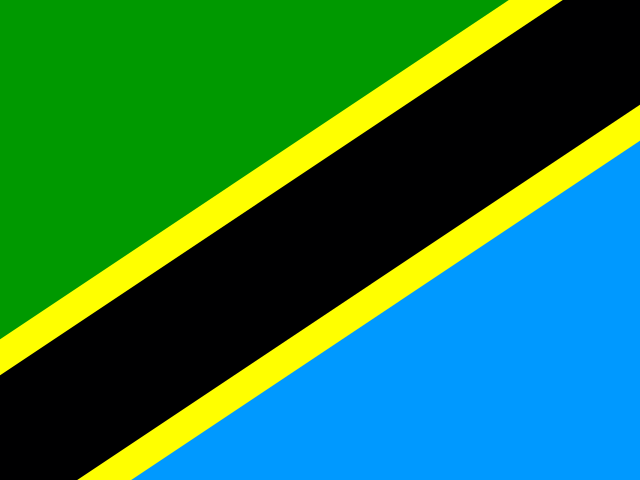
Flag of Tanzania

Tanzania: from Dar es Salaam to Dodoma (1970s–2019)

In the 1970s, under founding president Julius Nyerere, Tanzania chose Dodoma, in the centre of the country about 450 km west of Dar es Salaam, as its new capital. The idea was to spread development inland and bring government closer to people across the country. For decades, though, most offices stayed on the coast. The prime minister moved to Dodoma in 2017, ministries followed, and in 2019 the president's office completed the move. Dar es Salaam keeps the State House and remains the largest city and main port.

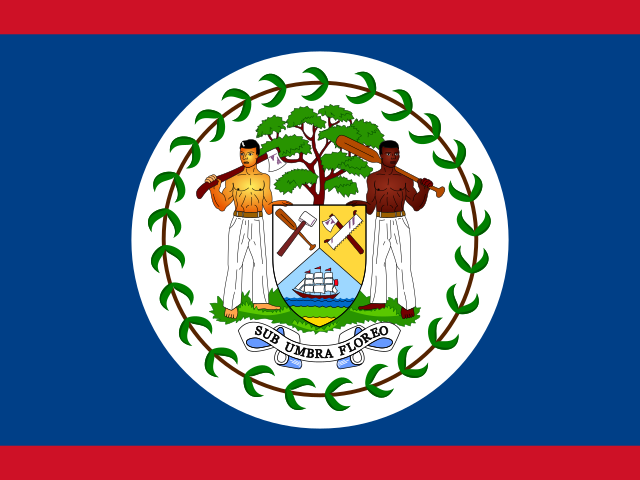
Flag of Belize

Belize: from Belize City to Belmopan (1970)

On 31 October 1961 Hurricane Hattie came ashore just south of Belize City, then the capital of British Honduras, and damaged most of its buildings. The government decided to build a new capital inland, on higher ground and better terrain that needed no costly land reclamation. In 1962 a site about 80 km south-west of Belize City was chosen, work began in 1967, and the government moved there in 1970. The name joins two rivers: the Belize, the longest in the country, and the Mopan.

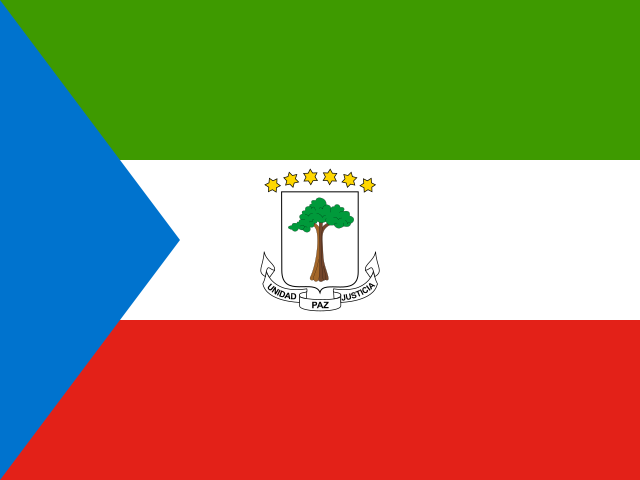
Flag of Equatorial Guinea

Equatorial Guinea: from Malabo to Ciudad de la Paz (2026)

Malabo sits on the island of Bioko, reachable only by air or sea, while much of the country's economic life is on the mainland around Bata. So the government planned a new city in the forest near the centre of Río Muni, the mainland part of the country, chosen for its easy access, milder climate and inland position. First called Oyala, it was named Ciudad de la Paz, 'City of Peace', in 2017, when government offices began moving there. A presidential decree in January 2026 declared it the capital and gave state institutions a year to move.

How to find them in the game

  • Aim away from the famous old city. Brasília, Abuja, Ankara, Dodoma and Belmopan were all placed inland, away from the coast. If your finger drifts towards Rio de Janeiro, Lagos, Istanbul, Dar es Salaam or Belize City, pull it back towards the interior.
  • Use the old capital as a landmark. Naypyidaw is about 320 km north of Yangon, Yamoussoukro about 240 km north-west of Abidjan, and Canberra about 285 km south-west of Sydney. Find the big city first, then move in that direction.
  • Mind the islands. Equatorial Guinea's old capital, Malabo, is on Bioko island, but Ciudad de la Paz is on the mainland, near the centre of Río Muni. Tap the island and you have found the old capital, not the new one.

Capitals that moved are some of the easiest places to get wrong, because the famous old city pulls your eye. Now that you know where each one went and why, try them on the globe in Tapital, or open the capital guides for Brasília, Abuja, Astana and the rest to learn more about each city.

Sources: Wikipedia: Nusantara (city), www.aljazeera.com/news/2022/1/18/nusantara-indonesias-parliament-passes-law-to-relocate-capital, en.tempo.co/read/2103601/indonesias-nusantara-capital-what-is-known-so-far, Wikipedia: Brasília, Wikipedia: Rio de Janeiro, Wikipedia: Juscelino Kubitschek, Wikipedia: Ankara, Wikipedia: Istanbul, Wikipedia: Canberra, Wikipedia: Old Parliament House, Canberra, Wikipedia: Walter Burley Griffin, Wikipedia: Bonn Act, Wikipedia: Bonn, Wikipedia: Berlin, Wikipedia: Reichstag building, de.wikipedia.org/wiki/Hauptstadtbeschluss, Wikipedia: Moscow, Wikipedia: Saint Petersburg, Wikipedia: Tokyo, Wikipedia: Kyoto, Wikipedia: Capital of Japan, Wikipedia: New Delhi, Wikipedia: Kolkata, Wikipedia: Abuja, Wikipedia: Lagos, Wikipedia: Astana, Wikipedia: Capital relocation in Kazakhstan, Wikipedia: Almaty, Wikipedia: Kazakhstan, Wikipedia: Naypyidaw, Wikipedia: Yangon, Wikipedia: Yamoussoukro, Wikipedia: Abidjan, Wikipedia: Basilica of Our Lady of Peace of Yamoussoukro, Wikipedia: Dodoma, Wikipedia: Dar es Salaam, Wikipedia: Tanzania, www.africanews.com/2019/10/15/magufuli-moves-to-tanzania-s-new-capital-dodoma/, Wikipedia: Belmopan, Wikipedia: Hurricane Hattie, Wikipedia: Ciudad de la Paz, Wikipedia: Malabo, Wikipedia: Equatorial Guinea, es.wikipedia.org/wiki/Oyala-Ciudad_de_la_Paz, www.myjoyonline.com/equatorial-guinea-changes-capital-ciudad-de-la-paz-replaces-malabo/, www.aip.ci/304296/cote-divoire-aip-inter-ciudad-de-la-paz-devient-officiellement-la-nouvelle-capitale-politique-de-la-guinee-equatoriale/