Play

Capitals that aren't the biggest city

Ask someone to name a country's capital and they will often guess its best-known city. That works for many countries, but not for all of them. In quite a few places the government sits in a smaller city, sometimes a much smaller one. The reasons tend to repeat. Two rival cities could not agree, so a third place was chosen. A government wanted a fresh start near the centre of the country, away from a crowded port. Or a capital was picked for reasons of history and never caught up with the big trading city. Here are 14 countries where the capital is not the largest city, why it happened, and how to find each one on the globe.

Flag of Australia

Australia: Canberra, not Sydney or Melbourne

When Australia's colonies federated on 1 January 1901, Sydney and Melbourne both wanted to be the capital. The compromise was a new city in New South Wales, at least 100 miles (160 km) from Sydney. The site was chosen in 1908, and the Chicago architects Walter Burley Griffin and Marion Mahony Griffin won the competition to design it in 1912. Parliament met in Melbourne until it moved to Canberra in 1927. Canberra is Australia's largest inland city, but Sydney and Melbourne are each many times bigger.
Flag of United States

United States: Washington, D.C., not New York City

New York City was the first capital under the US Constitution, and Philadelphia took over from 1790 to 1800. The permanent site came out of a deal struck in 1790 between Alexander Hamilton, Thomas Jefferson and James Madison: the federal government would take on the states' debts, and in return the capital would go south. The Residence Act put it on the Potomac River, and George Washington chose the exact spot, on land given by Maryland and Virginia. Congress first met there in November 1800. New York City is the country's largest city.

Flag of Canada

Canada: Ottawa, not Toronto

The Province of Canada, which came before modern Canada, could not settle on a capital. Kingston, Montreal, Toronto and Quebec City all had a turn between 1841 and 1865. In 1857 Queen Victoria was asked to choose, and she picked Ottawa, a small city on the Ottawa River, facing what is now Quebec across the water. It was acceptable to both the English-speaking and French-speaking parts of the province, and its distance from the US border made it easier to defend. Toronto, which served as capital twice, is Canada's largest city.

Flag of Switzerland

Switzerland: Bern, not Zürich

Strictly speaking, Switzerland has no capital. Its constitution does not name one, and Bern is officially the 'federal city', the seat of the government and parliament. It was chosen in November 1848, after a new federal constitution created the modern Swiss state. Zürich was already the economic powerhouse, and the deputies did not want all power concentrated there. Lucerne had been part of the Catholic alliance defeated in a short civil war the year before. Bern was more central and close to the French-speaking cantons, which backed it. Zürich is the largest Swiss city.

Flag of New Zealand

New Zealand: Wellington, not Auckland

Auckland was New Zealand's capital from 1841, but it lies in the north of the North Island. At the time there were fears that the South Island, which then had more people and the goldfields, might break away as a separate colony. Commissioners invited from Australia, chosen because they were neutral, recommended Wellington for its central position and good harbour, and Parliament first sat there in 1865. Auckland is New Zealand's largest city, while Wellington, at the south-western tip of the North Island, is the world's southernmost capital of a sovereign state.

Flag of Brazil

Brazil: Brasília, not São Paulo

Brazil's 1891 constitution already called for the capital to move to a more central spot, away from the heavily populated south-east. It took President Juscelino Kubitschek to make it happen. Lúcio Costa won the 1957 competition for the city plan, often compared to an aeroplane or a bird, and Oscar Niemeyer designed many of its landmark buildings. Brasília was built in 41 months and inaugurated on 21 April 1960, taking over from Rio de Janeiro. It is a UNESCO World Heritage Site. São Paulo is Brazil's largest city, and Rio comes second.

Flag of Nigeria

Nigeria: Abuja, not Lagos

Lagos, on the south-west coast, was Nigeria's capital from independence in 1960. It was becoming overcrowded, and there had long been plans for a capital on ground seen as neutral between the country's major ethnic groups. In 1976 the military government decided to build one near the geographic centre, construction started in 1979, and Abuja officially took over on 12 December 1991. Its landmark is Aso Rock, a granite outcrop that rises about 400 metres above the surrounding land, with the presidential complex, National Assembly and Supreme Court located around it. Lagos is Nigeria's largest city.

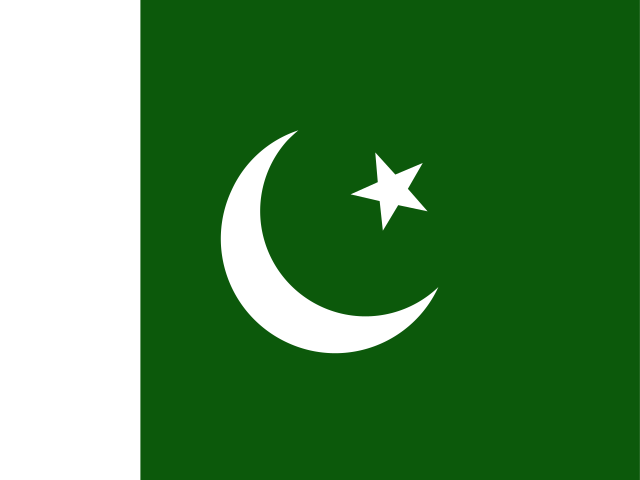
Flag of Pakistan

Pakistan: Islamabad, not Karachi

Karachi was Pakistan's first capital after independence in 1947. But it lies at the far southern end of the country, on the Arabian Sea, and as a business centre it was felt to give commercial interests too much sway over government. A commission chose a site in the north, next to Rawalpindi and its army headquarters, and Rawalpindi stood in as capital while the new city was built in the 1960s. The Greek architect Konstantinos Doxiadis laid Islamabad out on a grid at the foot of the Margalla Hills. Karachi is Pakistan's largest city.

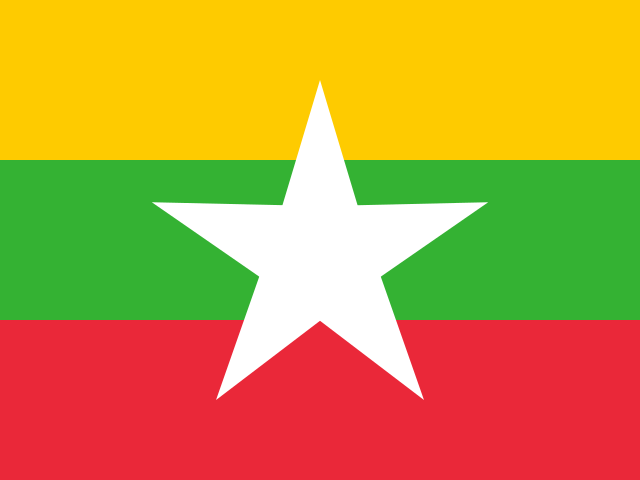
Flag of Myanmar

Myanmar: Naypyidaw, not Yangon

Yangon was the capital of British-ruled Burma and stayed the capital after independence. Then, on 6 November 2005, the government moved to a new city being built on open land near Pyinmana, about 320 km to the north. Its name, Naypyidaw, roughly means 'abode of the king', and was announced on Armed Forces Day in March 2006. Officials said Yangon was too congested to expand; observers have suggested other motives, including security. The new capital spreads over a huge area with few people, and has a 20-lane boulevard. Yangon is Myanmar's largest city.

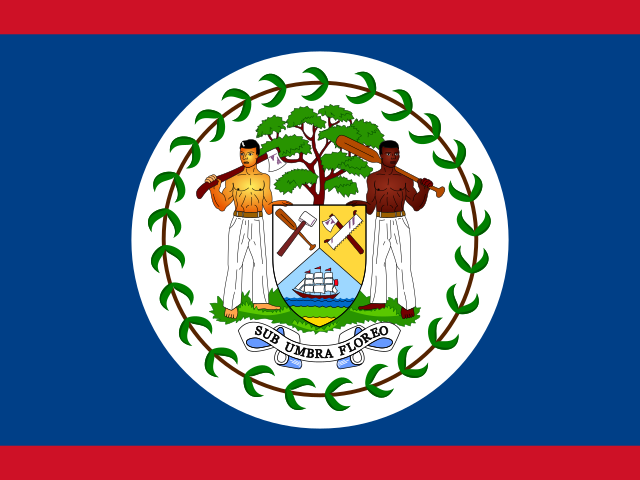
Flag of Belize

Belize: Belmopan, not Belize City

Belize City, on the coast, was the capital of what was then British Honduras. In October 1961 Hurricane Hattie hit it with a storm tide that reached the third storey of some buildings, and most of the colony's buildings were damaged. The government decided on a new capital about 80 km inland, on higher ground. Work began in 1967 and the government moved to Belmopan in 1970. Belmopan is a small town by capital standards, and Belize City is the country's largest city.

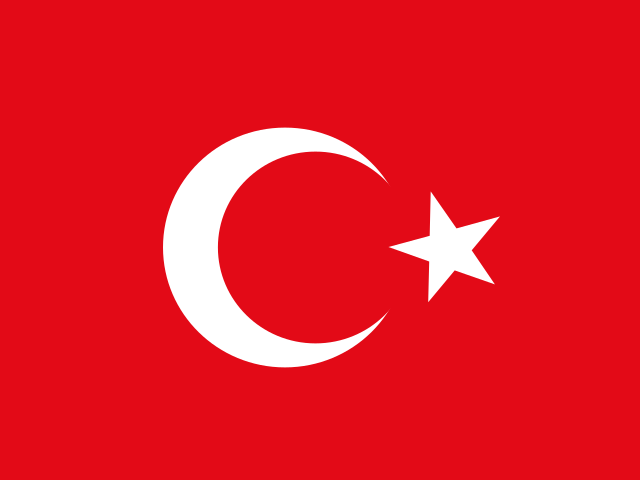
Flag of Türkiye

Türkiye: Ankara, not Istanbul

Istanbul was the Ottoman capital from 1453. After the First World War, Allied forces occupied it, and the Turkish national movement led by Mustafa Kemal, later known as Atatürk, made its base in Ankara, in the heart of Anatolia. The Grand National Assembly opened there in April 1920. In October 1923, the same month the republic was proclaimed, Ankara officially became the capital. Istanbul is Türkiye's largest city and economic centre, and Ankara is the second largest.

Flag of Morocco

Morocco: Rabat, not Casablanca

Fez was Morocco's capital when France made the country a protectorate in 1912. After riots that year, the French administrator, Hubert Lyautey, moved the capital to Rabat, on the Atlantic coast at the mouth of the Bou Regreg river. He liked its coastal position and its closeness to Casablanca, which he expected to become the economic centre. When Morocco became independent in 1956, King Mohammed V kept the capital in Rabat. Casablanca is Morocco's largest city, and Rabat is listed by UNESCO as a modern capital and historic city.

Flag of Ivory Coast

Ivory Coast: Yamoussoukro, not Abidjan

Abidjan, on the Ébrié Lagoon by the Gulf of Guinea, was Ivory Coast's capital until 1983. That year President Félix Houphouët-Boigny made his birthplace, Yamoussoukro, in the centre of the country, the official political capital. He also had the Basilica of Our Lady of Peace built there; Pope John Paul II consecrated it in 1990, and Guinness World Records lists it as the world's largest church. Even so, most government institutions stayed in Abidjan, which is officially the 'economic capital' and the country's largest city.

Flag of United Arab Emirates

United Arab Emirates: Abu Dhabi, not Dubai

When the United Arab Emirates was founded on 2 December 1971, its constitution said the capital would be a new town called Al Karama, built on the border between Abu Dhabi and Dubai within seven years. Abu Dhabi, on an island just off the coast, was named the temporary capital in the meantime. The new town plan was eventually dropped. Abu Dhabi was made the permanent capital in the 1990s, and the word 'temporary' was removed in a 1996 constitutional amendment. Dubai, further north-east along the coast, is the country's most populous city.

How to find them in the game

  • Aim inland for the planned capitals. Several of the big cities here are ports, such as Lagos, Karachi, Abidjan and Belize City, while the capitals that replaced them were placed away from the coast. Abuja, Brasília, Naypyidaw, Belmopan, Yamoussoukro and Canberra all sit well inland.
  • Use the famous city as your landmark. Canberra is south-west of Sydney, Washington is south-west of New York, Ottawa is north-east of Toronto, Rabat is north-east of Casablanca along the coast, and Abu Dhabi is south-west of Dubai. Ankara lies well east of Istanbul, in central Anatolia.
  • Watch the ends of the country. Wellington is at the bottom of New Zealand's North Island, not on the South Island, and Auckland is far to the north. Islamabad is in the north of Pakistan, beside Rawalpindi, a long way from Karachi on the southern coast.